home

Welcome to rudgeoriginals.com for
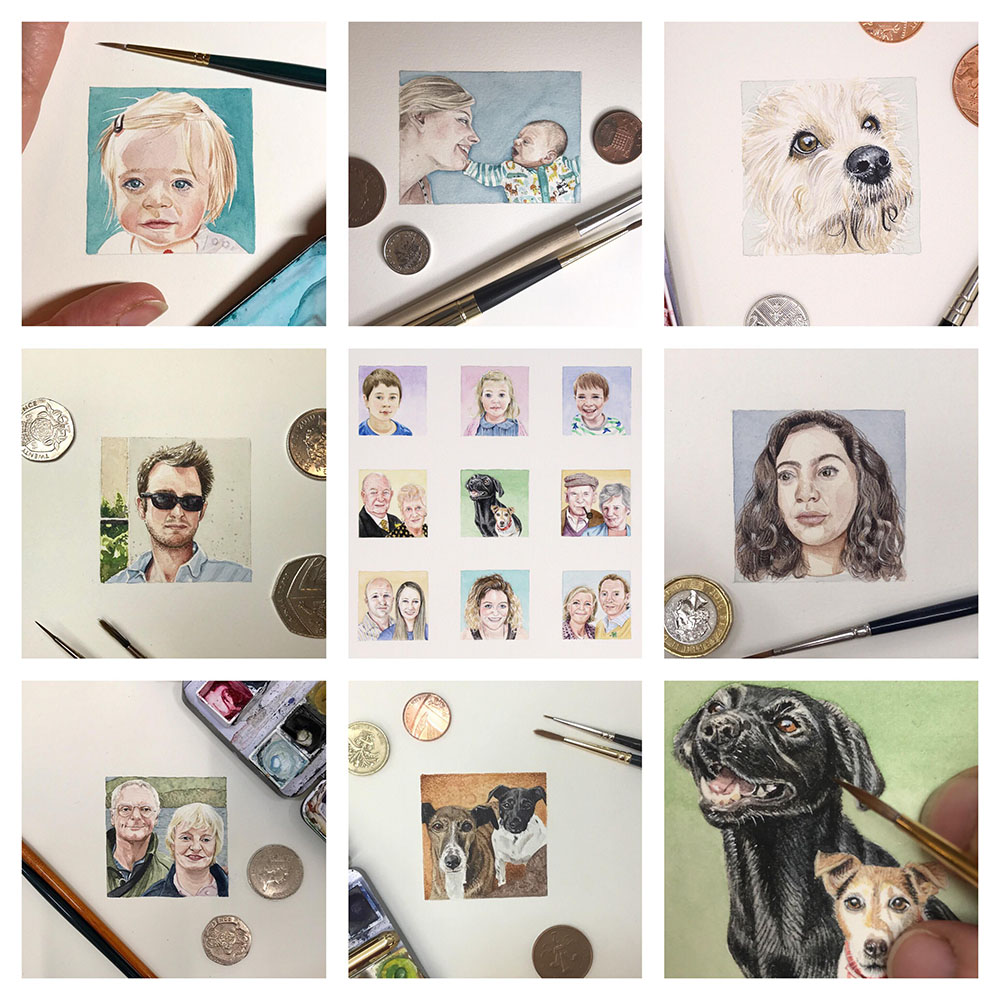
an original and creative take on the tradition of pet portraiture.
Every pet is different, so why not commission a unique and imaginative
pet portrait which captures the character and expression of your pet.
Visit the gallery
to view a variety of original pet portraits.... The portraits are exquisitely
rendered in paint, producing a contemporary and stylish representation
of your pet.
Click on order
for details on how to commission a pet portrait or other work.... rudgeoriginals.com
offers a tailor-made service for those who want a completely original,
contemporary and beautiful Fine Art pet portrait.
Caroline Rudge has an extensive background in pet portrait commissions,
and offers you the opportunity to own for yourself a truly unique portrait
of your pet. To read more about the artist, click on about.
Commission a pet portrait as a special wedding gift, birthday present,
anniversary or retirement gift, commemoration or as a unique pet portrait
painting for yourself.
For answers to questions regarding commissioning a pet portrait, click
on faq's,
or contact the artist.
about pets
A pet is an animal that is kept (mostly by humans) for companionship and enjoyment, as opposed to livestock, which are kept for economic reasons. The most popular are noted for their loyal or playful characteristics or their attractive appearance or song.
The term "pet" may also be applied to humans, usually in an endearing way by a lover, significant other, or partner. Calling another person a pet, though, can just as easily be considered an insult.
While in theory one could keep any animal as a pet, in practice a small number of species of mammals, especially dogs and cats, and other animals such as birds have dominated the pet scene for a very long time. Fish have joined them more recently. Many of these are domesticated while others, often considered novelty pets, are not. With the exception of tortoises, iguanas and non-venomous snakes, few reptiles and amphibians make good pets.
The glofish, a genetically modified zebrafish with a bright red fluorescent color is the first genetically modified (GM) animal to be engineered as a pet.
Pets can provide their owners with many health benefits. The keeping of pets has been shown to help remove stress. Walking a dog can also provide its owner (as well as the dog!) with exercise, fresh air, and the opportunity for social interaction.
A pet can be acquired from a pet store, an animal shelter, a breeder, and sometimes from people who have too many due to births.
Sometimes people treat their pets like they are children, especially when the people do not have children or their children are grown up.
Some animal welfare organisations have proposed that the term "companion animal" be used instead of "pet".
The captive gorilla Koko is one of few examples of a non-human animal which has had a pet. Koko's first pet was a kitten named All Ball.
about portraits
A portrait is a painting, photograph, or other artistic representation of (usually) a person. Portraits are often simple head shots or mug shots and are not usually overly elaborate. The intent is to show the basic appearance of the person, and occasionally some artistic insight into his or her personality.
The art of the portrait flourished in Roman sculptures, where sitters demanded realistic portraits, even unflattering ones. During the 4th century, the portrait began to retreat in favor of an idealized symbol of what that person looked like. In Europe true portraits of the outward appearance of individuals re-emerged in the late Middle Ages, in Burgundy and France.
One of best-known portraits in the Western world is Leonardo da Vinci's painting titled Mona Lisa, which is a painting of an unidentified woman.
Some of the earliest portraits of people who were not kings or emperors, are the funeral portraits that survived in the dry climate of Egypt's Fayum district. These are the only paintings of the Roman period that have survived, aside from frescos.
When the artist creates a portrait of himself, it is called a self-portrait. The first known in paint was by the French artist Jean Fouquet in c. 1450, but if the definition is extended the first was by the Egyptian Pharoah Akhenaten's sculptor Bak, who carved a representation of himself and his wife Taheri c. 1365 BC. However, it seems likely that self-portraits go back to the earliest representational art.
Portrait photography is a popular commercial industry all over the world. Many people enjoy having professionally made family portraits to hang in their house, or special portraits to commemorate certain events, such as graduations or weddings.
Since the dawn of photography people have made portraits. The popularity of the daguerreotype in the middle of the 19th century was due in large part to the demand for inexpensive portraiture. Studios sprang up in cities around the world, some cranking out more than 500 plates a day. The style of these early works reflected the technical challenges associated with 30-second exposure times and the painterly aesthetic of the time. Subjects were generally seated against plain backgrounds and lit with the soft light of an overhead window and whatever else could be reflected with mirrors.
As photographic techniques developed, an intrepid group of photographers took their talents out of the studio and onto battlefields, across oceans and into remote wilderness. William Shew's Daguerreotype Saloon, Roger Fenton's Photographic Van and Mathew Brady's What-is-it? wagon set the standards for making portraits and other photographs in the field.
In politics, portraits of the leader are often used as a symbol of the state. In most countries it is common protocol for a portrait of the head of state to appear in important government buildings. Excessive use of a leader's portrait can be indicative of a personality cult.
In literature the term portrait refers to a written description or analysis of a person or thing. A written portrait often gives deep insight, and offers an analysis that goes far beyond the superficial. For example, American author Patricia Cornwell wrote a best-selling book titled Portrait of a Killer about the personality, background, and possible motivations of Jack the Ripper, as well as the media coverage of his murders, and the subsequent police investigation of his crimes.
The term portrait also describes the orientation of a rectangular piece of paper, painting or other graphic, denoting that the long axis is vertical. When the long axis is horizontal, it is said to be in landscape mode.
about dogs
The dog is a canine mammal of the Order Carnivora that has been domesticated for at least 24,800 years and perhaps for as long as 150,000 years based on recent evidence. In this time, the dog has been developed into hundreds of breeds with a great degree of variation. For example, heights range from just a few inches (such as the Chihuahua) to nearly three feet (such as the Irish Wolfhound), and colors range from white to black with reds, grays, and browns also occurring in a tremendous variation of patterns. Dogs, like humans, are highly social animals and pack hunters; this similarity in their overall behavioral design accounts for their trainability, playfulness, and ability to fit into human households and social situations. Dogs fill a variety of roles in human society and are often trained as working dogs. For dogs that do not have traditional jobs, a wide range of dog sports provide the opportunity to exhibit their natural skills. In many countries, the most common and perhaps most important role of dogs is as companions. Dogs have lived with and worked with humans in so many roles that their loyalty has earned them the sobriquet "mans best friend."
about cats
The cat, also called the domestic cat or the house cat, is a small feline carnivorous mammal of the subspecies Felis silvestris catus. Its most immediate, pre-domestication ancestor is the African wild cat, Felis silvestris lybica. The cat has been living in close association with humans for at least 3,500 years; the Ancient Egyptians routinely used cats to keep mice and other rodents away from their grain. The history of the domestic cat may stretch back even further, as 8,000-year-old bones of humans and cats were found buried together on the island of Cyprus[1]. Currently, the cat is one of the world's most popular household pets.
A group of cats is referred to as a clowder, while a male cat is called a tom, and a female is called a queen. An immature cat is called a kitten (which is also an alternate name for young rats, rabbits, hedgehogs, beavers, and squirrels). A cat whose ancestry is formally registered is called a purebred cat, a pedigree cat, or a show cat. Purebreds are less than one percent of the total feline population; cats of mixed ancestry are referred to as domestic longhairs and domestic shorthairs.
There are dozens of breeds of domestic cats, some hairless or tailless, and they exist in a variety of different colors including multicolored. They are skilled predators and have been known to hunt over one thousand different species for food. They are also intelligent animals: some are able to manipulate simple mechanisms such as lever-handled doors and flush toilets. They communicate by calling ("meow"/"miaou"), purring, hissing, and gesturing. Because the domestication of the cat is relatively recent, cats may also still live effectively in the wild, often forming small colonies. The cat's association with humans leads it to figure prominently in the mythology and legends of several cultures, including the ancient Egyptians, Vikings, and Chinese.